


Views: 0 Author: Site Editor Publish Time: 2026-07-28 Origin: Site


A 10 kW wind turbine rarely produces 10 kW all day. Wind changes, and real output changes alongside it. This makes nameplate ratings easy to misunderstand.
Actual wind turbine electricity production depends on wind speed, tower height, rotor size, and system losses. In this guide, you will learn how to estimate annual output and choose a practical turbine size.
The short answer ranges from a few hundred to millions of kilowatt-hours yearly. A small wind turbine may support a cabin or monitoring station. A utility-scale unit may serve a large grid, yet neither runs at rated power continuously.
Power measures the production rate at one moment. We express it in watts, kilowatts, or megawatts. Energy measures accumulated electricity, so bills and annual forecasts use kilowatt-hours.
A 5 kW rating means the turbine can deliver 5 kW under specified conditions. It does not promise 5 kW during every operating hour. The capacity factor describes actual energy relative to continuous rated production.
Use this simple estimate:
Annual output (kWh) = rated power (kW) × 8,760 × capacity factor
Rated power | At 15% capacity factor | At 25% capacity factor | At 35% capacity factor |
1 kW | 1,314 kWh/year | 2,190 kWh/year | 3,066 kWh/year |
5 kW | 6,570 kWh/year | 10,950 kWh/year | 15,330 kWh/year |
10 kW | 13,140 kWh/year | 21,900 kWh/year | 30,660 kWh/year |
These are mathematical scenarios, not guaranteed yields. One 1 kW wind turbine at 25% averages about 6 kWh daily. Seasonal production may still rise far above or fall below that average.
A 10 kW unit at the same factor averages 60 kWh daily. Its monthly total would average about 1,825 kWh. Actual months will differ because wind conditions rarely follow a flat schedule.
Real small-wind performance varies widely. A U.S. distributed-wind report found a 15% average capacity factor in one 2022 sample. Individual results ranged from 1% to 37%, showing why site data matters.
GWZK offers Wind Turbine - Efficient Energy Generation, plus matched controllers and inverters. Its listed range includes compact models and units up to 30 kW. Buyers should compare each model using the same site wind data.
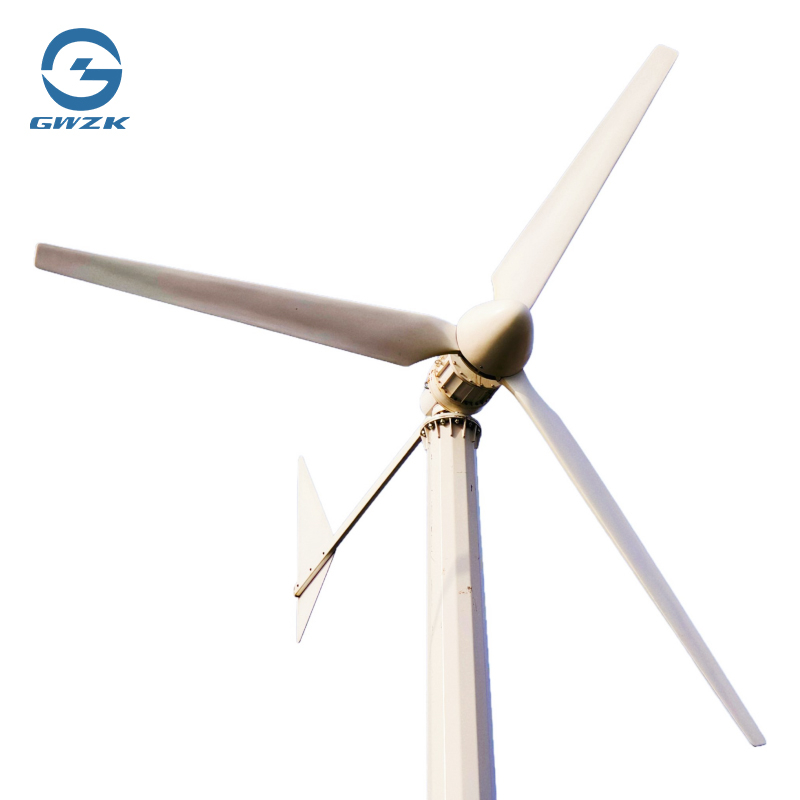
Two equal-rated turbines can produce very different annual energy. One may stand above an open ridge. Another may sit behind trees, where weak and turbulent air reaches the rotor.
Available wind power rises roughly with the cube of wind speed. Doubling wind speed can provide eight times more energy in the airflow. The turbine captures only part of it, and its controls limit output safely.
Every serious estimate needs a power curve. It shows expected electrical output across wind speeds. The curve also identifies three important operating points.
Cut-in speed: The turbine begins useful electricity production. Spinning alone does not confirm usable output.
Rated speed: The unit reaches its nameplate power. Stronger wind may not raise output further.
Cut-out speed: Controls stop or limit the rotor for protection. Extreme wind can therefore reduce production.
Factor | Why it changes annual energy | What to verify |
Wind distribution | Frequent moderate winds may outperform rare strong gusts | Hourly speeds at planned hub height |
Rotor swept area | A larger rotor intercepts more moving air | Rotor diameter and power curve |
Hub height | Higher air is often faster and less turbulent | Tower options and local obstacles |
Air density | Thin, warm, or high-altitude air carries less energy | Elevation and design conditions |
Turbulence | Buildings and trees cause unstable loading | Clear exposure and setback |
Losses | Wiring, inverter, battery, icing, and downtime reduce delivery | Net-output assumptions |
The Small Wind Guidebook recommends annual energy output as the better performance measure. It calls for the power curve, wind distribution, tower height, site features, and elevation. That process is more reliable than using average wind speed alone.
Do not place a turbine on a roof simply because the roof is high. Nearby edges create turbulence and repeated mechanical stress. A clear tower location usually offers cleaner airflow and more predictable wind turbine power output.
Sizing starts at the meter, not in a product catalog. Collect at least twelve months of electricity bills. Add monthly kWh values, then note seasonal peaks and any planned new loads.
Interval meter data adds another useful layer. It shows when pumps, motors, heating, or production lines create demand. That timing helps estimate self-consumption and storage needs.
1. Measure annual energy demand. Separate kWh from peak kW demand. Energy determines yearly coverage, while peak power affects inverter and backup requirements.
2. Choose a coverage target. A grid-connected system might offset 30% or 70% of annual use. An off-grid design must also survive low-wind periods.
3. Assess wind at hub height. Wind maps provide useful screening, but they cannot see every tree or building. On-site measurements and a professional assessment reduce uncertainty.
4. Select a realistic capacity factor. Use the candidate turbine's power curve and hourly wind distribution. Do not borrow a utility wind-farm average for a small residential machine.
5. Apply system losses. Include wiring, controller, inverter, battery, availability, icing, and curtailment where relevant. Keep each assumption visible instead of hiding everything inside one optimistic percentage.
6. Check monthly balance. Annual totals can hide winter shortages or summer surpluses. Off-grid users need the worst expected season, not only a yearly average.
For a preliminary size, use:
Required kW = annual load × target coverage ÷ [8,760 × gross capacity factor × (1 − losses)]
Suppose a property uses 12,000 kWh yearly. The owner wants wind to cover 80%. The modeled gross capacity factor is 25%, while total losses are 10%.
Required kW = 12,000 × 0.80 ÷ (8,760 × 0.25 × 0.90) = 4.87 kW
A 5 kW wind turbine becomes a reasonable candidate, not a final answer. Next, run its power curve against the site's hourly wind data. Confirm net monthly output, tower height, voltage, inverter limits, and grid rules before ordering.
The same formula works across many applications. However, the inputs must reflect each project's wind resource and operating goal. The examples below use simplified assumptions for early screening.
Application | Annual load | Wind coverage | Gross factor and losses | Preliminary turbine size |
Home | 10,800 kWh | 80% | 20% and 10% | 5.48 kW |
Farm | 60,000 kWh | 50% | 25% and 10% | 15.22 kW |
Workshop | 150,000 kWh | 30% | 30% and 10% | 19.03 kW |
Remote telecom site | 1,460 kWh | 100% | 15% and 15% | 1.31 kW |
Treat every result as a starting range. Rounding upward may cover uncertainty, but oversizing can create curtailed energy and higher costs. Better wind measurements usually improve the decision more than generous rounding.
The home might screen a 6 kW class turbine. Yet a weaker site could require a larger rotor or lower coverage target. Improving tower exposure may add more useful energy than buying extra nameplate capacity.
The farm and workshop can usually retain the grid for balancing. Their first target may be daytime loads, pumps, ventilation, or predictable production equipment. Load timing affects self-consumption, economics, and any export agreement.
The remote telecom case needs deeper analysis. Its annual total looks small, but reliability may be critical. Designers must model low-wind days, battery autonomy, inverter surge, and a backup source.
For a manufacturer example, GWZK lists its GWS-10KW Horizontal Axis Wind Turbine from China manufacturer at roughly 15,000–20,000 kWh annually. That range implies about a 17%–23% capacity factor for a 10 kW rating. It remains a planning estimate until local wind and loss assumptions are applied.
Always request the exact power curve behind any annual-output claim. Ask whether the estimate is gross generator output or net delivered electricity. Also confirm assumed hub height, air density, availability, and electrical losses.
Turbine capacity is only one purchase decision. The rotor, tower, controls, inverter, protection, and storage must operate as one system. A mismatch can waste energy or create repeated shutdowns.
Installation conditions matter just as much. Confirm foundations, crane access, cable distance, grounding, lightning protection, and maintenance space. Local planning and electrical rules may also control tower height or grid connection.
Horizontal-axis wind turbines usually suit open locations offering a prevailing wind direction. They often use tall towers to reach cleaner airflow. Their power curves remain essential because rotor diameter differs among equal-rated models.
Vertical-axis turbines accept wind from different directions and can simplify some installations. However, changing direction does not make turbulent urban air energy-rich. Compare measured output, structural loading, service access, and sound before choosing either design.
Grid-tied systems offset on-site consumption or export energy. They need a compatible inverter, disconnects, protection, permits, and utility approval.
Off-grid systems need batteries, charge controls, dump loads, and backup planning. Battery capacity follows load autonomy and seasonal wind, not turbine kW alone.
Wind-solar hybrids can reduce seasonal gaps. Their controller and storage system must accept both sources without exceeding voltage or charging limits.
Before purchase, request a certified power curve and an annual energy table. The table should cover several average wind speeds and tower heights. Also review survival wind speed, braking, corrosion protection, warranty, spare parts, maintenance intervals, and remote monitoring.
Ask the supplier to state every loss assumption. Confirm whether output is measured before or after the controller and inverter. For battery systems, verify charging voltage, maximum current, battery chemistry, temperature limits, and dump-load capacity.
GWZK combines wind turbines, controllers, inverters, distribution equipment, and storage within project packages. Buyers can provide wind data, annual load, voltage, grid status, tower constraints, and required autonomy. Those inputs support a site-specific proposal instead of a rating-only quotation.
A wind turbine's rating shows peak capability, not yearly electricity. Reliable sizing starts with annual load, hub-height wind data, a power curve, and honest loss assumptions.
Calculate a preliminary size, then test monthly performance and system compatibility. That approach produces a safer investment and a more dependable energy plan.
A: At a 15%–35% capacity factor, it produces roughly 1,314–3,066 kWh yearly.
A: No turbine maintains rated power throughout the day. It reaches that output only under specified wind conditions.
A: Each model has different wind requirements. Measure hub-height wind and compare it against the model's power curve.
A: Divide targeted annual kWh by expected net production per rated kilowatt.
A: Use daily critical loads, required autonomy, discharge limits, seasonal wind, and backup availability.


